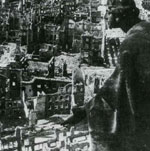
Dresden after being bombed at the end of the Second World War
Dresden Tourist Office:
www.dresden-tourist.de

FRONT PAGE
Site Search
About us

Dresden: 800 years
Dresden City Hall
Historic Cities: Western Europe
Historic Cities: Eastern Europe

Worldwide | Elections | North America | Latin America | Europe | Asia | Africa |

























Dresden: Building a modern city
on 800 years of European history
By Gregor Gosciniak
11 May 2006: Seventeen years after the Berlin Wall came down and communism finally disappeared from the German map, the City of Dresden, the capital of the East German state Saxony, continues to develop without respite and is already acknowledged as being among the most beautiful cities in Europe.
After more than a decade of achievement in restoration and redevelopment, a truly great milestone was reached on 30 October 2005: The Dresden Frauenkirche (Church of our Lady) was re-opened after eleven years of rebuilding. The first Baroque church of the new millennium again dominates the Dresden skyline. The history of the Dresden Frauenkirche and the story of its rebuilding are set out in an impressive exhibition that opened in October, 2005, and is scheduled to run until 2010 on the second floor of the Baroque Landhaus. This building is expected to be completed on 25 September 2006 with the opening of the new permanent exhibitions of the Dresden City Museum.
Right on time for the city’s 800th jubilee, the new permanent exhibitions offer a complete overview of the history of Dresden. The city will also use the occasion of the jubilee as a platform for sustainable city marketing and city branding: The official curtain for the Dresden Jubilee Year 2006 is to be raised with the 1st Dresden Opera Ball in the Semper Opera House on 13 January. True to the motto “Time for Dresden”, the Saxon capital will be offering an abundance of events, festivals and exhibitions throughout the whole year.
The first climax will be the Jubilee Week from 14 to 23 July 2006, when the whole city will be turned into a stage. With the opening of the Historical Green Vault in the Dresden Royal Palace, Dresden will be able to boast yet another historical sight of world renown from mid-September 2006. There, over 3,000 masterpieces of the jeweller's and goldsmith's art, treasures in amber and ivory, and vessels studded with precious stones can be admired in a uniquely conceived exhibition. The Dresden city centre will also be changing its appearance over the course of 2006.
The diamond of the Frauenkirche is to be placed back in its original setting: Dresden's historical heart is currently being reborn around the Neumarkt, partly with old facades, partly with discreetly modern frontages. The Steigenberger hotel group is to reopen the Hotel de Saxe this month – after a break of 117 years. Dresden’s main railway station is to have a new white membrane roof. The project for redesigning the station will be dedicated to modernity along the plans of the renowned British architect Sir Norman Forster. Completion is expected during the jubilee year.
Another spectacular architectural project is to be found to the north of the city centre. Daniel Libeskind and Hans-Günter Merz provided the plans for redesigning the Military History Museum. The changes in the architecture are to go hand in hand with changes in the overall concept of the permanent exhibitions. A tour will provide an overview of German military history, taking up the previously targeted fundamental issues in historical, technical and artistic contexts.
The ambivalent meaning of military history is also expressed in Libeskind's architecture: A glass wedge breaks out of the Classicist facade of the museum building. This mixture of events and building activities show that Dresden´s modernisation continues apace, even in these times when German cities have to cope as never before with difficult financial situations. Dresden is combining the general promotion of the city with the setting of new landmarks – an interesting approach in difficult times.