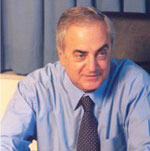
Dr Kiriakos Virvidakis, Mayor of Chania, Crete

Municipality of Chania
29 Kythonia str
73135 Hania
Greece
Tel: (+30) 2821 92000
Fax: (+30) 2821 93300
Internet:
http://www.chania.gr


FRONT PAGE
Site Search
About us |
Quiénes somos |
A propos de nous | Über uns |
Mayor Monitor
Directories
Events
Debate


European mayors
World Mayor
World index of mayors
Mayor Monitor

Mayors from Europe
| Amsterdam | Antwerp | Athens | Barcelona | Berlin | Bologna | Bonn | Bremen | Chania | Cologne | Córdoba | Evry | Doncaster | Gothenburg | Kraków | La Laguna | Lewisham | Lille | London (Johnson) | London (Livingstone) | Middlesbrough | Montreuil-sous-Bois | Moscow | Munich | Nicosia | Nuremburg | Paris | Rhodes | Rome (Alemanno) | Rome (Veltroni) | Rouen | Sofia | Stockholm | Stuttgart | Tallinn | Tirana | Turin | Vienna | Wroclaw | Zurich (Ledergerber) | Zurich (Mauch) |


City Mayors reports news from towns and cities around the world. Worldwide | Elections | North America | Latin America | Europe | Asia | Africa | Events |


Mayors from The Americas, Europe. Asia, Australia and Africa are competing for the annual World Mayor Award. More


City Mayors ranks the world’s largest as well as richest cities and urban areas. It also ranks the cities in individual countries, and provides a list of the capital cities of some 200 sovereign countries. More


City Mayors reports political events, analyses the issues and depicts the main players. More


City Mayors describes and explains the structures and workings of local government in Europe, The Americas, Asia, Australia and Africa. More


City Mayors profiles city leaders from around the world and questions them about their achievements, policies and aims. More


City Mayors deals with economic and investment issues affecting towns and cities. More


City Mayors reports on how business developments impact on cities and examines cooperation between cities and the private sector. More


City Mayors describes and explains financial issues affecting local government. More


City Mayors lists and features urban events, conferences and conventions aimed at urban decision makers and those with an interst in cities worldwide. More


City Mayors reports urban environmental developments and examines the challenges faced by cities worldwide. More


City Mayors reports on and discusses urban development issues in developed and developing countries. More


City Mayors reports on developments in urban society and behaviour and reviews relevant research. More


City Mayors deals with urban transport issues in developed and developing countries and features the world’s greatest metro systems. More


City Mayors examines education issues and policies affecting children and adults in urban areas. More


City Mayors investigates health issues affecting urban areas with an emphasis on health in cities in developing countries. More


City Mayors examines the importance of urban tourism to city economies. More


City Mayors examines the contributions history and culture make to urban society and environment. More


City Mayors describes the history, architecture and politics of the greatest city halls in the world. More


City Mayors invites readers to write short stories about people in cities around the world. More


City Mayors questions those who govern the world’s cities and talks to men and women who contribute to urban society and environment. More


City Mayors profiles national and international organisations representing cities as well as those dealing with urban issues. More


City Mayors reports on major national and international sporting events and their impact on cities. More


City Mayors lists cities and city organisations, profiles individual mayors and provides information on hundreds of urban events. More

Dr Kiriakos Virvidakis
Mayor of Chania, Crete
By Sophie Ziogou

23 February 2005: Kiriakos Virvidakis was elected Mayor of the Crete city of Chania in the local elections held in October, 2002, and in January, 2003. Kiriakos Virvidakis has been short-listed for the 2008 World Mayor Award.

Join the debate on Mayor Virvidakis

Chania, built on the ruins of ancient Kidonia, has seen and survived many invaders, but has also experienced many different civilizations which all left their marks on the city’s built environment. The city can be reached through the airport of Akrotiri, and the port of Souda. The city’s own harbour goes back to Venetian times, when Chania was favoured by Venetian nobility.

Kiriakos Virvidakis was born in Chania in 1948, the son of Epaminondas and Catherine. In Chania he finished his studies in high school in 1965, and six years later, in 1971, he obtained a Grade A degree in medicine at the University of Athens. In 1977 he gained his Master’s degree in pathology, and one year later his doctorate in teaching in the same university. In 1980 he achieved his speciality qualification in nephrology.  Since 1993 he has been Assistant Professor in the Department of Nephrology at the University of Athens and in the Sotiria (Salvation) Hospital.

He and his wife, Irene Katsifaraki, from Galata Kidonia, Crete, have two children, Epaminonda, 28, and Catherine, 25.

Below is an outline of his contribution to medicine, athletics, local government and science.

Kirkiakos Virvidakis has worked in hospitals for more than 23 years, 19 of them dedicated to Athens University. Over the past seven years he has imparted his specialist knowledge to Chania Hospital, Crete. Despite all this, he has also announced and published the results of more than 150 scientific research projects. He is a member of many Greek and international scientific associations, including the International Society of Nephrology, the European Renal Association, the Royal Society of Medicine (UK) and the National Kidney Foundation (USA).

He was a member of the Administration Council of the Union of Doctors in Athens and Piraeus (1982-1983); General Secretary of the Medical Society of Chania (1984-1987); and Vice President of the Federation of the Union of Hospital Doctors in Greece (1988-1989). From 1986 until 1989 he was President of the Council of Crisis, an organisation within the Greek medical society on which personnel in hospital foundations are represented. Since 1999 he has been a member of that Council, representing the University of Athens. Between December,1993, and September, 1996, he published articles dealing with common queries in medical matters in a regular column in a local newspaper under the heading "Kirikas" (“Doubts").

In addition to all that, Dr Virvidakis was also a famous athlete, both in track and field events. He was an athlete of the Union of Talo and Kodon Chania, and was a member of the Greek national teams in track events between 1966 and 1973. He has been Vice President of Kodon Chania and a member of the administrative council of the Naval Association of Chania (representing the municipality of Chania). He has also held memberships of many other associations. As a member of the city’s Climbing Union, he led many climbing expeditions. Representing the union of Kodon, Dr Virvidakis was a member of the Administrative Council of the Hellenic Federation of Weight Lifting from 1977 until 1988. Representing the Weight Lifting and Boxing Unions, he served as a member of the Committee of the Olympic Games from 1981 to 1984. He was also a Dean (proctor) of the Panathenean Stadium (1981-1983); member of the Olympic Committee of Preparation (1981-1983); and charged with overseeing the work of the Ergometric Center of Athletic Research (1981-1983).

He became a member of the International Federation of Weight Lifting in 1980 and since 1997 he has held the office of Secretary of its Health Committee. He has been a member of the European Federation Health Committee on Weight Lifting since 1987 and has held the office of President of that organisation since 1999, an office that he had previously held between1991 and 1993. Since 2000 he has represented the International Federation of Weight Lifting on medical matters in the committee called "Athens 2004" and in the World Olympic Committee. As the representative of that committee, Dr Virvidakis, participated in the organisation of all those Olympic Games held since 1980 (Los Angeles, Seoul, Barcelona, Atlanta, Sidney).

In 1986 Dr Virvidakis was elected first (in votes) as Local Councillor of the city of Chania from among all the political combinations. He has been a member of the Central Union of the political party "New Democracy" (today the governing party) from 1986 to 1989 and between 1991 and 1994. He returned to that position in 2001. He became a member of the Central Committee on Matters of Local Government in that particular political party in 1987 and remained until 1989. In that year he became General Secretary of Athletics, while in November, 1989, and April, 1990, he was elected MB Member of Parliament for Chania under the "support" of "New Democracy". Between 1991 and 1993 he served once again as General Secretary of Athletics.

His political activity has also resulted in the successful coordination and organisation of the Mediterranean Games, the signing of the two days Athletic Agreement of Cooperation between European and the Mediterranean countries, and his participation in the International Athletic Organization and the impressive effort he has put into the area of Athletic Works.

In 1998 he was elected Local Councillor for Chania, made leader of the minority party, and in 1999 he became a member of the administrative committee in the Local Union of Municipalities and Cities in Chania, as well as a member of the Local Council of the Central Union (of Municipalities and Cities). He has also participated in the committee concerning the "Development of the human personnel - New Technologies and practices in the function of the organization of Local Government". As a representative of the Central Union of Municipalities and Cities, he has taken part in the Council of the Organization against Drugs, in the Committee of Planning Health Treatment in the Ministry of Health and Welfare, as well as participating in the ministerial team on administrative work in relation to volunteering in the Ministry of Internal Affairs.   

Kiriakos Virvidakis was elected Mayor of the city of Chania in the local elections held in October, 2002, and in January, 2003.  When he officially took charge of his duties, he also became a member of the administrative committee of the Local Union of Municipalities and Cities in the county of Chania.

The artificial kidney unit of the General Hospital of Chania, which Kiriakos Virvidakis leads, won an award from the Hellenic Committee of Nephrology after being judged the best county unit throughout 1984 to 1986. Last but not least, Dr Virvidakis, has been honoured internationally. His distinguished awards include the "President's Diploma of Honor" and the "Gold" and "Bronze" Order of IWF.


Comment & Debate
City Mayors is inviting its readers to engage in a debate on the issues raised in the article on this page. Please post your comments below. Your comments should deal with the topics of this article and must be legal and ethical. You may also reply to and/or challenge comments of other readers. While we endeavour to publish all relevant comments, we reserve the right to edit them and to reject unsuitable contributions.

Please add your comment
Title of article
Your comment relates to the article on this page:


Your name
Please provide your name as you wish it to be published. It can be your full name, first name, initials or a nickname. (Impersonating someone else is unacceptable.)


Your city and country
Please provide the city and country you live in. (Example: Paris, France)


Your email address
Please provide your email address. (Your email address will NOT be published)


Your comment
If possible, please provide your comment in English, using upper and lower cases. Please mention if you refer to a comment of another reader.


Mayor Monitor allows you to rate the performance of your mayor More


How good is
your mayor?

City Mayors provides Mayor Monitor (MM) to allow residents and non-residents to rate the performance of mayors from across the world as well as highlight their ‘best’ and ‘worst’ decisions. Mayor Monitor uses the widely understood one-to-ten rating system, where '1' signifies an extremely poor performance and '10' ‘an outstanding one. In addition to rating mayors’ performances, citizens are invited to highlight the best and worst decisions by city leaders.

Over time, Mayor Monitor will provide a valuable track record of mayors’ successes and failures as well as their popularity among residents and a wider public. The results will be published on the City Mayors website and updated monthly.

Please rate your mayor now.

The ratings will become a contributory factor of World Mayor 2010.