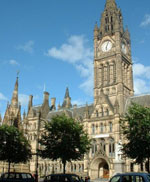
Manchester is described as the city's most magnificent building

FRONT PAGE
Site Search
About us | Quiénes somos |
A propos de nous | Über uns |
Mayor Monitor
Directories
Events
Debate

City Halls: Europe
| Aachen | Antwerp | Athens | Berlin | Birmingham | Bolton | Bradford | Bremen | Brighton | Cardiff | Cologne | Cork | Dresden | Florence | Glasgow | Hanover | Innsbruck | Jena | Leeds | Liverpool | London | Manchester | Moscow | Munich | Neuss | Paris | Sheffield | Southampton | Stockholm | Stuttgart | The Hague | Vienna |
City Halls: The Americas
| Bogota | Boston | Buenos Aires | Chicago | Houston | New York | Philadelphia | Pittsburgh | San Francisco | Seattle | Toronto | Vancouver |
City Halls: Asia + Australasia
| Ekaterinburg | Sydney | Tokyo | Wellington |

City Mayors reports news from towns and cities around the world. Worldwide | Elections | North America | Latin America | Europe | Asia | Africa |

City Mayors ranks the world’s largest, best as well as richest cities and urban areas. It also ranks the cities in individual countries, and provides a list of the capital cities of some 200 sovereign countries. More

City Mayors profiles city leaders from around the world. More

City Mayors describes the history, architecture and politics of the greatest city halls in the world. More

Mayors from The Americas, Europe. Asia, Australia and Africa compete for the World Mayor Award. More

Use Mayor Monitor to rate the performance of mayors from across the world More

In your opinion: Praise Criticise. Write

City Mayors reports political events, analyses the issues and depicts the main players. More

City Mayors describes and explains the structures and workings of local government in Europe, The Americas, Asia, Australia and Africa. More

City Mayors deals with economic and investment issues affecting towns and cities. More

City Mayors describes and explains financial issues affecting local government. More

City Mayors reports urban environmental developments and examines the challenges faced by cities worldwide. More

City Mayors reports on and discusses urban development issues in developed and developing countries. More

City Mayors reports on developments in urban society and behaviour and reviews relevant research. More

City Mayors invites readers to write about the people in their cities. More

City Mayors examines city brands and marketing. More

City Mayors lists and features urban events, conferences and conventions aimed at urban decision makers and those with an interst in cities worldwide. More

City Mayors deals with urban transport issues in developed and developing countries and features the world’s greatest metro systems. More

City Mayors examines education issues and policies affecting children and adults in urban areas. More

City Mayors investigates health issues affecting urban areas with an emphasis on health in cities in developing countries. More

City Mayors reports on how business developments impact on cities and examines cooperation between cities and the private sector. More

City Mayors examines the contributions history and culture make to urban society and environment. More

City Mayors examines the importance of urban tourism to city economies. More

City Mayors questions those who govern the world’s cities and talks to men and women who contribute to urban society and environment. More

City Mayors profiles national and international organisations representing cities as well as those dealing with urban issues. More

City Mayors reports on major national and international sporting events and their impact on cities. More

City Mayors lists cities and city organisations, profiles individual mayors and provides information on hundreds of urban events. More
City Mayors reports news from towns and cities around the world. Worldwide | Elections | North America | Latin America | Europe | Asia | Africa |
City Mayors ranks the world’s largest, best as well as richest cities and urban areas. It also ranks the cities in individual countries, and provides a list of the capital cities of some 200 sovereign countries. More
City Mayors profiles city leaders from around the world. More
City Mayors describes the history, architecture and politics of the greatest city halls in the world. More
Mayors from The Americas, Europe. Asia, Australia and Africa compete for the World Mayor Award. More
Use Mayor Monitor to rate the performance of mayors from across the world More
In your opinion: Praise Criticise. Write
City Mayors reports political events, analyses the issues and depicts the main players. More
City Mayors describes and explains the structures and workings of local government in Europe, The Americas, Asia, Australia and Africa. More
City Mayors deals with economic and investment issues affecting towns and cities. More
City Mayors describes and explains financial issues affecting local government. More
City Mayors reports urban environmental developments and examines the challenges faced by cities worldwide. More
City Mayors reports on and discusses urban development issues in developed and developing countries. More
City Mayors reports on developments in urban society and behaviour and reviews relevant research. More
City Mayors invites readers to write about the people in their cities. More
City Mayors examines city brands and marketing. More
City Mayors lists and features urban events, conferences and conventions aimed at urban decision makers and those with an interst in cities worldwide. More
City Mayors deals with urban transport issues in developed and developing countries and features the world’s greatest metro systems. More
City Mayors examines education issues and policies affecting children and adults in urban areas. More
City Mayors investigates health issues affecting urban areas with an emphasis on health in cities in developing countries. More
City Mayors reports on how business developments impact on cities and examines cooperation between cities and the private sector. More
City Mayors examines the contributions history and culture make to urban society and environment. More
City Mayors examines the importance of urban tourism to city economies. More
City Mayors questions those who govern the world’s cities and talks to men and women who contribute to urban society and environment. More
City Mayors profiles national and international organisations representing cities as well as those dealing with urban issues. More
City Mayors reports on major national and international sporting events and their impact on cities. More
City Mayors lists cities and city organisations, profiles individual mayors and provides information on hundreds of urban events. More
Manchester Town Hall
By Gregor Gosciniak
10 May 2005: Manchester Town Hall, a Grade I listed building and arguably the English city’s most magnificent monument, was built between 1868 and 1877 after the old Town Hall became too small for its purposes. Alfred Waterhouse, one of Britain’s most renowned architects of the time, won the competition to build the new Town Hall.Judged purely in terms of appearance, Alfred Waterhouse's design only came fourth in the competition. However, he made better use of the triangular site and his design provided better access, light and ventilation. In London Alfred Waterhouse was responsible for the design of buildings such as St Pancras Station, the Natural History Museum in South Kensington and the Prudential Insurance Building in Holborn.
He was tasked to design a municipal building, which underlined the importance of Manchester to England and the British Empire in the 19th century. The building was to include council offices, the council meeting room, the mayor’s office and various function rooms. The new City Hall was also to incorporate a Great Hall, which is today used for large-scale receptions.
While Alfred Waterhouse designed Manchester Town Hall in a style reminiscent of 13th Gothic architecture, he also included innovative technologies such as a warm-air heating system. Some fourteen million bricks were used in the construction of the Town Hall. The bulding’s exterior is adorned with a number of sculptures, including statues of St. George, Henry III and Elizabeth I. Manchester Town Hall’s main entrance is guarded by a statue of Agricola, the Roman general who founded Manchester in 79 AD.
The Town Hall features an impressive 85 metres high clock tower, which houses 24 bells. The biggest one weighs over eight tons and is named ‘Great Abel’ after Mayor Abel Heywood, who governed Manchester when the new Town Hall was officially opened in September 1877. Town Hall’s main Albert Square entrance features a striking archway.
An interesting feature in the glass mosaic ceiling of the entrance hall is a concealed oak trapdoor, through which the bells can be lowered to street level. Statues of the philosopher and scientist John Dalton and the physicist James Joule are also part of the entrance hall. Further statues in the sculpture hall depict orchestra conductor Sir John Barbirolli, John Bright, conductor Sir Charles Halle and Richard Cobden.
Manchester Town Hall’s three staircases are named after England, Scotland and Ireland as a reminder that the granite used in their construction came from those three countries.
The Great Hall, the Lord Mayor’s parlour, the reception room with figures of truth and justice, the banqueting hall with its two large fire places and the conference hall, which was originally the council chamber, are all on the first floor of Manchester Town Hall. The ceiling of the Great Hall is divided into panels, which are decorated with the coats of arms of the cities and nations Manchester traded with in the past. The Hall’s mosaic floor bees and cotton flowers are depicted, symbolising the past importance of the cotton trade to Manchester. The bee is also part of the City’s coat of arms.
During building, Venetian craftsmen laid down some 4,000 metres of marble flooring in City Hall – one of the reasons why the total building costs amounted to more than one million pound sterling, a staggering sum of money to be spent on a municipal building in the 19th century.
Today, 128 year after Manchester City Hall’s official opening, the building and its later extensions house the city’s government consisting of some 3,500 staff. The building is also one of Manchester major tourist attractions.